The Sleep Gunner is trying to record a record next week, and in preparation for that we're rethinking some arrangements. This is really just an impro that happened while I was seeing how my Octava condenser sounded with the dobro, and the answer is "thin and crispy". But the approach to SJC is maybe useful for something. And yes that's the sound of traffic outside.
Satan's Jewelled Crown. (5.3MB, 3:15).
Mark Morse: dobro, laptop
+++
Showing posts with label Studies. Show all posts
Showing posts with label Studies. Show all posts
Monday, August 6, 2012

Friday, March 23, 2012
disable.

Above: today's recording setup.
Below: Let me explain. Though he's certainly made plenty of bullshit music, I've liked/admired/been confused by Keiji Haino's guitar playing in Fushitsusha for a long time. His solos (especially in the early live recordings) are totally mystifying: definitely arranged in phrases, but in a language that is primitive and atonal to the point of sounding completely deranged or chemically disabled.
It's a style that I've tried to emulate before, but only in a kind of unconsidered, half-assed way. I'm going to try and eventually record some more fully-assed attempts here, but this is the first.
Haino Study. (2.2MB, 0:55).
Me: Guild hollowbody, Fuzz Factory, ebow.
+++
factory of fuzz.

So after 15 years or so of coveting one, I bought a Zvex Fuzz Factory. The photo above is to document my settings for these studies. In a couple of these it really sounds like there's an effect other than fuzz involved, but there ain't: in the 1st study, the E and B string are tuned a minor second apart, so it sounds like there's a chorus or vibrato thing happening; and what sounds like a seriously damaged or unpredictable gate in the 2nd study is just the superball bouncing maniacally.
Fuzz Slide. (7.2MB, 3:01).
Fuzz Mallet. (8.8MB, 3:52).
Me: Guild hollowbody, Fuzz Factory, homemade superball mallet, glass slide.

+++
Thursday, March 15, 2012
saturday night.

I find myself kind of accidentally opening up for Thurston Moore next Saturday night. Not just me of course, unless something seriously accidental happens: it'll be a quartet of lovely-seeming local gentlemen, at least they seem lovely via email, we've never played together.
And thus, we shall have a week of guitar studies/recordings.
SSA. (5MB, 2:00).
Me: Telecaster, ballpoint pen, SP-404.
+++

Sunday, March 4, 2012
sunday study.

Yeah there's a lot of synthy stuff up in this bitch lately, if you're here for manlier, guitar-oriented things, just scroll down 4 or 5 posts....
+++
Getting ready to do some playing that looks like it will involve some.....eh, electronics. Which I don't do so often anymore, and I've stopped using most of the pedals and things I used to use b/c fuck, they were all 15 years old and starting to sound like it. I mean, effects that sound 30 years old are fine, but 15...that puts us at an unfortunate moment in the evolution of guitar effects. I also just got tired of effects in general, and kind of stopped understanding the point.
But, so, now, in the interest of coming up with a new and useful effects setup that is both somehow good and also reflects my fatigue with "regular" effects, I wanted to try plugging the guitar into this Audioweevil feedback thingie I had going on. It's something I think I did with Minister Kebab once or twice but that was so long ago I don't really remember how it worked or if it was any good.
I've arrived at something that sounds OK but is logistically a bit over-complicated since it uses two amps, but it goes like this: guitar-->cube-->sampler MIC in-->sampler PHONES out-->Audioweevil in-->Audioweevil out-->sampler LINE IN-->sampler LINE OUT-->second amp. The cube wouldn't be totally necessary for live playing but kind of is for recording, otherwise you end up with a rather shitty dry direct guitar sound.
Anyway. This is a simple E-bow drone on a detuned A string, run through the harmonizer on the sampler. Then I turn up the Audioweevil and start knobtwisting.
Sunday Study. (11MB, 4:50).
Me: Telecaster, Audioweevil, feedback, SP-404 fx, reverb.
+++
Monday, February 27, 2012
in, out, repeat.

Went to see Christer's long, long-awaited show yesterday...I think I first talked to her about it maybe 5 years ago? I wasn't sitting in the best place: I couldn't get comfortable and the sound was a little unbalanced, both of which are kind of critical for a 90-minute drone performance.
But if I didn't have a perfect physical experience, the music itself must've made me think about something: I woke up this morning and did this longer-than-usual study while thinking about yesterday: can't say that the music has anything to do with Christer's approach, but well that's not always what inspiration's about now is it.
This is a BugBrand AudioWeevil (pictured, above) cabled up to feed back through itself and my Roland SP-404 sampler (the sampler is necessary for recording b/c it has an in and two outs). This is three takes layered together.
Hennix Study. (50MB, 22:49).
Me: audioweevil, feedback.
+++
Tuesday, February 21, 2012
cue exposure.

It's a bummer that Roland discontinued the Micro Cube this year: it weighed about 3 kg, so you could wear it around; had a 5-inch speaker driven by 2 watts of power, fueled by 6AA batteries. I always liked most everything about it except the built-in noise gate that you can't turn off, but oh well.
My point is: I'm recording with it right now b/c yeah, I can't be bothered to set up a microphone and my real amp, so this is the sound of the Cube going direct out to my soundcard, monitored through my stereo. It's like I'm in high school. That awesome hum is my Telecaster. It's such a shitty sound that it's almost OK.
+++
Cube Study. (7MB, 03:09).
Mark Morse: Telecaster, glass slide
+++
Sunday, March 20, 2011
unprepared.

+++
Solo Study v-8.
Solo Study v-5.
Mark Morse: 12-string guitar
+++
Wednesday, March 16, 2011
multifingered.

Before I started playing with other people again, back in 2007 or something, I was doing a lot of solo multitrack recordings, basically kind of playing with an idea for 2 or 3 minutes, then recording another take without hearing the first one, and then a third without hearing the first two, etc. Then I would nudge some things around in Sound Forge to synchronize events that were interestingly nearby each other. Anyway yes here are three of those kinds of things, probably recorded in 2006.
Wond.
Omeg.
Pipe.
Mark Morse: guitar, AudioMulch.
+++
Monday, February 7, 2011
tuesday's screwed.

I like nice easy accidents like this. This is David Bowie's Subterraneans mashed up against Lynyrd Skynyrd's Tuesday's Gone. I just dropped them both an octave and started them at the same time, fading in the Skynyrd. I'll hopefully get around to a more considered edit of this soon, I need it for a new theater piece.
Morsanek: Tuesday's Screwed (demo).
+++
While I was slowing things down, I decided to finally mess with the recently-ballyhooed super slowdown tool, Paul's Extreme Sound Stretch. It's...OK, if you're not looking for realism. The artifacts are nicely different. Here it is applied to a harmonium loop I've got bigger plans for.
Morsanek: WAFTUG Incidental (demo).
+++
Thursday, November 25, 2010
solo studies iv: dirt.

Tonight I finally turned up the volume knob on my trusty sidekick Le Blues Junior, and together we laughed, we cried, we used ridiculous doubleneck slides. Here are some results, all using one or two "9" mutes. And a couple of them have reverb, yeah sorry.
+++
Study 19 starts out with pedestrian tinkles, but it's interesting to have 18 strings to use instead of 6; unexpected breathy sounds from rubbing inside of forearm on muted bottom string of top neck; pretty decent clarinet emulation until it's revealed that I'm playing a flute carved from a tree branch, badly.
Solo Study iv-19 (behind bridges twinkles, elbow breathing, pedicure bridge on bottom neck pickup, foil mute on top bridge pickup, ebow).
+++
20a gradually brings the background into the foreground by exaggerating fret noise.
Solo Study iv-20a (top neck, plastic slide, drinking straw bridge).
+++
Kind of just a little Sonic Toothish exercise in keeping material on both necks going simultaneously with mostly non-repeating chords.
Solo Study iv-20e (top neck harmonics, bottom neck rhythm).
+++
Sunday, November 21, 2010
solo studies iii.

There will be about 10 in total this time around, I'll be uploading them as I sort through the takes. And then deleting them again as I come to realize they suck (see study 16).
As objects/preparations, they're getting weirder but not necessarily better; but on the upside I seem to be getting a little more efficient/resourceful/ooh dare I say smarter in working with objects. And plus it's keeping me out of trouble, unless you count my dabbling with reverb on a few takes.
SOLO STUDIES III
This first one is a useless freak of a thing, but I've never seen or heard of it before, so I hereby share it with the world, who may already be doing this left and right, WTF, maybe I'm the last to know, who knows. I feel like a useless freak myself for "discovering" it, but you gotta believe me, I didn't spend hours on it, it just happened, you'll see how in 2 seconds.
+++

So there I was, dorkily taking pictures of preparations when I dorkily realized that hey, my camera makes noise. And not in a bad cell-phoney way. Here are the complicated instructions: turn on your digital camera and hold it right next to your pickups. That's it! Try it!
With my shitty camera I found that there were about 6 different constant/rhythmic sounds, one for each side of the rectangular block that is The Camera. So most of the variation you hear in the study is me rotating the camera around and bringing it closer/farther to/from the pickups. I don't know a single thing about science, but is it probable that the LCD screen is probably the source of this sound?
One way to interrupt the constant sounds is to put something like a finger in front of the lens (with autofocus on), and you get a slightly different sound for a few secs. Much cooler than that (but not really useful on a regular basis) is the sound that happens when you depress the Take a Picture Now button (actual name?) so that your infrared laser thingie comes on but you don't actually take a picture. This is the quick synthish melody you hear towards the end of the first version of the study. Taking a picture sounds completely different and sadly, less cool (you hear this at the end of the second version)...it sounds like maybe the SD card being accessed, you also hear something similar at the beginning, I think this is turning the camera on.
So, nifty. But in terms of a technique you can learn and develop, this isn't it: it's pretty limited sonically if you're not using effects pedals, which we're not. You will notice below that I exploited a loophole in the no-effects-pedals rule and did one take with my amp reverb turned up all the way...yes, I feel guilty about it and would like to say I won't do it again but in fact I know that's not true. I also included a totally dry take for reference.
Solo Study iii-15 (camera with amp reverb).
Solo Study iii-15 (camera dry).
+++
 This one's an orphan from last week, I don't remember what I was doing. What typically happens is, I press REC, play for 2 minutes and quickly decide if it sounds like anything or not and then jot down what I did technically, but I must not have liked this one when I did it b/c I have no jottings, I imagine b/c it's a bit too close to Bela Fleck Plays Gnawa pastiche. But it turns out that now I do like the oud-dy-ness of it all and the gimbri elements in the bass, though I wish I'd left out the one or two most obvious stock "Middle Eastern" articulations that snuck in there.
Solo Study iii-14 (shortened scale on bottom neck and playing behind the capo on top neck).
+++
The one pictured here and at the top is something I haven't quite figured out yet. It involves using a thundermaker, part of which is essentially a giant guitar string, pressing it up against your pickups, and at least one ebow. The prep as it's currently evolved isn't pictured b/c i've got an ebow in each hand and the camera has to be held innit.
Basically, as notes for myself: there is one ebow that works on the thundermaker, mark it with something: hold that ebow with its front facing upwards at you; optionally put foil on the neck pickup to prevent unplanned loud noises.

+++
Awesome name aside, the thunderstick doesn't quite work yet. Plus you look like an ass when you're doing it. Instead, we move on to a wonderfully rhythmic, abrasive, and unpredictable prep. It involves:
1) a large metal baking spatula at around the 2nd or 3rd fret, going UOUOUO (under-over), and then continuing on to the bottom neck, under your top "E" string and over all the rest. It should wobble.
2) a foam mute underneath the bottom 4 strings on the bottom neck.
3) the ebow.
4) technique: keep the ebow on the neck with your left hand, use either pickup, and ebow your fifth string. You will get an unpredictable pitch with a rhythmic component due to the suspended spatula being vibrated. You modify the pitch and the vibration rate by either a) moving the ebow closer or farther from the spatula (changing the string length); b) pressing down on the sixth string (not the one you're ebowing) to tighten the suspension of the spatula; c) moving the spatula to a position directly over a fret; d) changing the string length at the bridge side with your right hand palm or index finger.
The fact that you've got the ebow in your left hand lets you do useful things like work your volume and tone controls with your right hand, or mute the string.

Solo Study iii-17a (baking spatula, one ebow, foam mute, dry).
Solo Study iii-17b (baking spatula, one ebow, foam mute, reverb).
+++
Like a lot of wobbly things, the baking spatula is a little unpredictable.Say, what if there was a much more subtle and reliable prep that was almost as good? This is a 1/2 cm-thick rectangle of aluminium foil on my bridge pickup and an ebow. OK, it's not really almost as good, but...if you play this take and the two above at the same time it sounds like Machine Gun's first album at quarter-speed. Try it!!!
Solo Study iii-18a (aluminium mute, bottom neck, ebow, dry).
+++
I am liking this next thingie a lot, it's reliable and surprising at the same time. They have these everywhere in Amsterdam, and every guitar player seems to have one:

It's some kind of squishable metal scrubber. Pros: it's loud, and you can use it in either hand with different results, plus it's well-suited to playing non-guitar sounding rhythms, with or without a simultaneous e-bow component, held in either hand. It's textures become more diffuse and mysterious with a touch of reverb (but what doesn't really), so we have quickish examples of:
Solo Study iii-16c (metal scrubber + left hand fretting, less dry).
+++
Speaking of funny-looking things on stage, here's something I'm working on:

It's the movable one-hand ebow/slide combo. Can almost do it good, the hard part is a) keeping the ebow far enough away from the slide for there to be enough string length to vibrate, and b) at the same time keeping your slide parallel to the fingerboard. But when it works it's pretty unusual.
+++
Friday, November 5, 2010
solo studies II.

Continuing with preparation documentation, plus pictures to aid my aging memory. This first quick one is another version of the knitting needle trick from the last post. In the photo above you can kind of see my 3rd and 4th fingers on my right hand grabbing and moving the needle while ebowing. The thing I've added here is using fret-changing as a rhythmic component: since it's an unavoidable and loud artifact of what I was originally messing with, might as well do something useful with it.
Solo Study 2c (knitting needle/ebow).
+++
Almost every prep I do ends up shortening the string length and thus the scale (could that be b/c it's way more difficult to lengthen the string?), but this one is specifically aimed at trying to emulate violin-like glissandos with an ebow and slide.. Here's what this prep looks like as recorded, but you could use anything as your third bridge, I just happen to like the sound of this wooden spatula at the 17th fret. And then you ebow on the nut side of your wooden spatula equivalent. The capo is there to bring the strings closer to the neck so that they always touch the spatula.
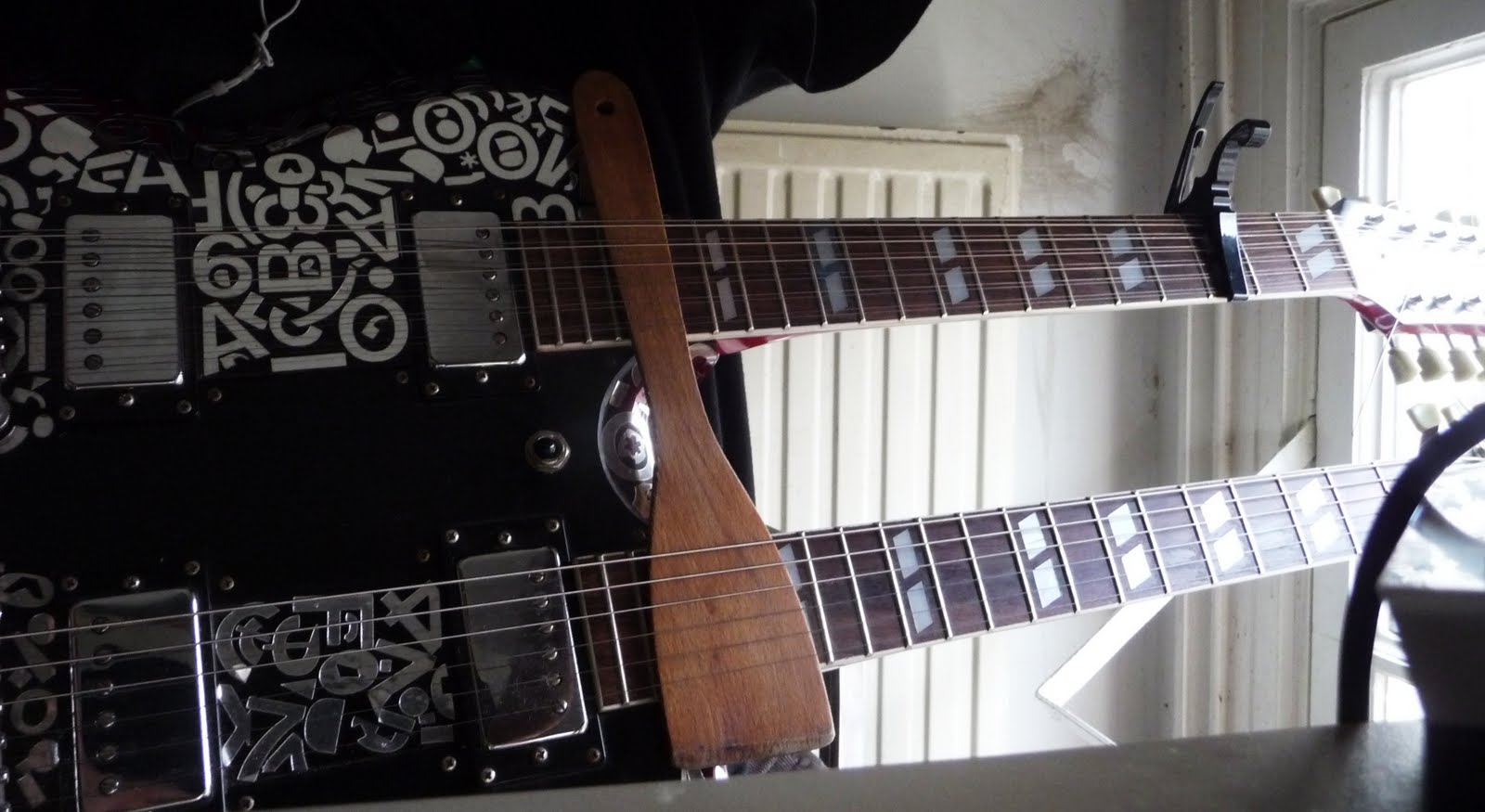
Solo Study 8 (short scale, ebow, slide, wooden spatula).
+++
This one is using a large flat metal baking spatula over the bridge pickups and, yeah, something I can't quite remember is fucking up the 12-string neck (EDIT: I've remembered it's this little cheese knife). I'm also holding a slide in my left hand and picking in front of the slide also with my left hand with some random finger. I might also have an ebow in my right hand. Again, not totally sure. I like this one because the loud weirdness of the spatula hitting the pickup magnets creates a range of attacks that are almost digital-sounding or like a badly-edited cassette.

Solo Study 10 (baking spatula).
+++
This one isn't much of a performance, but there's something very interesting going on in terms of timbre. I'm pretty sure I'm using two precariously balanced metal spatulas that begin wobbling asynchronously, and at some points there's an odd static-y distortion that pops up. Typically this happens when a mute comes in contact with one of the pickup magnets but I don't think that's the case here. Anyway, the point of these three clips is: take notes.
Solo Study 11 (baking spatulas).
+++
Tying up loose ends: here's a picture of the two superball mallet technique from last post, as well as the "hard foam slide":


Sunday, October 24, 2010
solo studies.

UPDATE: Geeky pictures that illustrate some of these things can be found here.
+++
So, ja, a week or so ago, I played a set of solo improvised no-FX guitar in public for the first time in my fucking life.
Embarrassing, I know. How is that possible. I guess it's two things: my lack of non-failure-based motivation, and plus...I'm shy? I don't know, I guess for a long time I focused on doing creative things with analog/digital processing gunk and over the past 3 or 4 years have kind transferred that interest into doing it without the gunk.
But, so, whatever: I agreed to do this solo thing, mostly because I'd never never done it before. And in the end it went OK, it was fun, but alas, oops, shit: the night's performances weren't recorded. And since I spent quite a bit of time building some preparations to improvise with that night, I thought I'd write down the recipes. Mostly for myself because I'm notoriously bad at repeating inspired concoctions, but also I figured that someone else out there might be at home Googling "homemade superball mallet" like I was last week, and well now here's one more relevant result.
+++
Quick setting: like a lot of prepared guitar, many of these sounds are the result of creating one or more extra bridges. I'm really starting to dig on soft or fibrous materials for bridges b/c of their unpredictability (foam and aluminium foil are my go-to materials right now) and odd timbres when ebowed.
I'm calling these studies, I guess that's what they are. Basically I fuck around with a technique/setting/set of objects until I can predict some of what will happen, then I press REC and play for about two minutes or so, because this is the default setting for my attention span.
I'm trying to be as musical as possible but in some cases I fail more than others: I was mostly in a hurry to capture my gross sonic intentions so I could retune and restring my ridiculous guitar and get on down the road.
Yes, the recording quality is crap: I could apply some gloss and sweetener via some reverb, EQ, spectral infusionators and whatnot...but also I'm a sucker for ugly-ass guitar, and this is supposed to be the raw naked shit, people! I'm trying to put the gunk behind me. So yeah this is just a guitar, a cable, and an amplifier. And some foam.
+++
SOLO STUDIES.
Before I lose this tiny crinkled scrap of paper with this 12-string tuning on it, I write it here, yes? Thickest string to thinnest string:
BC GA DB GbEb BC DbEb:
I think it can maybe best be described as Eb Altered? Maybe some kind person who understands harmony can confirm/deny.
I didn't write down the tuning for the 6-string neck b/c in this case the open strings aren't used for distinct pitches, and if you're going to get inspired and retune while playing, the bottom neck is the one to use (listening to or watching someone tune a normal guitar onstage is one of the All-Time Great Boring Stage Events, but listening to or watching someone tune a 12-string guitar onstage is like spending all day at the dentist's office. I can only imagine what it's like watching someone tune their 12-string neck onstage and THEN move on to tune their 6 string neck, because anyone who's ever tried it has probably been killed immediately).
All that's important for this first set of studies is that the 5th and 3rd strings are slacker than their neighboring strings (for ebowing).
+++
So these first studies are using especially snappy foam mutes under the strings at the pickups and then a capo on the top neck. By snappy I mean foam that is very dense and squeaky (two words you almost never see together, or at least not often enough), not like a sponge, but almost like styrofoam? To get the greatest variety of sounds, it seemed to work well to have the double-muted neck on its neck pickup and the capoed 12-string neck on bridge pickup, remembering to play inside all newly bridged areas (behind capo, between capo and mute, between mutes, behind mutes, etc).
Most of the bass is coming from the lower neck and the harmonics-esque notes are coming from the 12-string neck, which means, if you're careful, you can one-handedly pluck out interesting clusters of notes that you wouldn't have access to on a 6-string neck.
Musically, yeah. The development kind of officially stalls a bit around the two-minute mark because 1) as I mentioned, that's the default setting for my attention span, and 2) I was wanting to slide the capo down a fret but couldn't find a good time to do it.
Why the pretentious Braxtonesque nomenclature: I've had to number my mutes because they're all cut special (for example, this prep idea can also be done usefully with mutes 7 and 9, with quite a different result), and for now it's helpful to remember what goes where. I can imagine getting tired of these names pretty quick, so if they go away, well let's call it natural selection.
Solo Study 1 (mutes 1 + 4 + 10 capo 4).
Solo Study 1a.
That could be some kind of digital glitch at the beginning, because I proudly use Tascam! but it could also be this pickup-palming thing I was doing. This take is not so hugely different from the first, but it does emphasize a new farty bass sound that i like very much (from sliding the lower mute back towards the bridge), and yes also fewer pitched sounds, more metallic timbres, etc. I also include this take to remind me that it can be almost OK to fingertap as long as you don't sustain anything, use vibrato, or accidentally sound like slap bass.
+++
Solo Study 2 (knitting needle at 12th fret through both necks, ebowing on headstock side of needle while moving needle with ebow hand).
This is a hard-to-do and almost definitely stupid-looking right hand position that involves a) grabbing the exposed bottom (hee hee!) of the 12th-fret knitting needle with your right-hand pinky so you can wiggle it while you ebow, b) holding on to the ebow as far away as you possibly can from the 12th fret (otherwise there's not enough string length for it to vibrate), for me this is around the 7th fret, which leaves frets 1-6 available for non-tempered fretting with the left hand, and c) leaving your right ring finger free to rudely plunk the string you're ebowing now and then. I like how this generates some very Ab sounds (that's Ab Baars, not A flat).
Solo Study 2a (excerpt).
+++
Solo Study 3 (knitting needle at 12th fret through both necks, ebowing with one ebow on each neck, headstock side, moving knitting needle with mouth).
This is one of those non-musical performances where it's all about documentation. The point here was to figure out how to use two ebows, holding one in each hand, and still coming up with interesting ways to add vibrato and change pitch and timbre. I was really surprised that the 12-string neck doesn't add much here, I was hoping to get 3 simultaneous notes, but without a fretting finger you can't really get the top neck string pairs to sound both notes reliably: thus, you usually hear one ebow note per neck.
The more abrasive timbres here are what happens when you push the needle off the neck via your mouth or chin...and so it's kind of like you're fretting the string from the underside of the string (not with your chin, luckily)?
Note to self: for playing the knitting needle with the mouth, I really have to find a way to not crack a tooth or Mara will kill me, probably just a firm piece of (non-toxic!) foam. I also thought maybe a pencil eraser would work, assuming those still exist. Besides tooth breakage the other downside of this preparation is that it's totally possible to start, eh, drooling, a guitar problem you don't see every day.
+++
Solo Study 4 (superball mallet).
This is a homemade mallet built from a superball crazyglued onto a metal kebab skewer. Unfortunately it doesn't even do the thing that I made it to do, which is to make an awesome squawky sound when you drag it across a lacquered hollow object like, say, a cello: my doubleneck isn't hollow enough.
BUT, the mallet has a couple of other interesting properties: the skewer has a ring at one end so you can loosely dangle it off your finger and let gravity do most of the work, which actually allows the ball to bounce. Here's two mallets at the same time, both dangling from right hand fingers, which takes some practice. This time I'm also "fretting" with this slide made of hard green foam, that I'll also play by itself in a second.
Solo Study 4b (two superball mallets).
+++
Solo Study 5 (hard foam slide).
I guess this isn't truly a preparation, I'm just playing slide with this thing I was just talking about, the bouncy green foam that does an awesome job of finding harmonics and letting them ring. I just like the sound of it. The final 30 seconds or so of this are really braindead wanking and I would normally edit that shit out but I was running out of steam and wanted to finish this little project.
+++
Solo Study 6 (two knitting needles, two ebows).
I could have included this in the knitting needle/double ebow discussion, but this one is kind of different and less versatile. Because you've got 4 bridges now (nut, two needles, actual bridge), the area between the two needles is really resonant and gives you lots of interesting but difficult-to-pitch sounds, which is why it's sometimes useful to use one of the ebows pressed up against the string so that it's fretting a pitch while it's vibrating the string.
+++
Friday, September 18, 2009
i am sitting in a NastyReverb contraption.

Just got back from a long week in Berlin, long in a good way. One of the week's successes was the glitch-free debut of my new tiny laptop/guitar rig running AudioMulch. So I thought I'd post a Mulch MP3 or two, recorded last week.
I'm normally quite the anti-loopist these days, probably because I spent many years looping and just eventually became a bit fatigued by the sound of it and the playing strategies that it traps one into. But nonetheless these are a few loopy guitar improvisations through one of the example patches that comes with Mulch version 2.
It's a patch written by Christian Haines called lucier.amh, and it's supposed to kind of coarsely emulate the resonant frequencies techniques used in I Am Sitting in A Room, though here there are no real rooms involved: these are the resonant frequencies of one NastyReverb contraption and five two-second SDelays (along with a bit of "nice" reverb at the end of the chain, added by me, which I realize completely smooths over and destroys any remaining vestiges of Lucier's intended soundworld, but...I don't think I was ever aiming for that anyway).
This is a simple patch, but an interesting and useful way to degrade or erode a shortish loop. In each of these recordings I stop playing after about 3 minutes, which is a little too soon musically: if I'd had a bit more patience I could've paced the first five minutes better, but the sooner I stop adding new material, the sooner the loop can start to degrade, and that degradation is what these studies were about. So that means that in each study there's an absence of development from the 3:00 mark to 5:00 minutes while I wait for the resonance to kick in.
#15 and #14 below are super-friendly and modal, and the other two are a little less so. #11 and #12 are so similar it's worth asking why you'd include both, but I guess maybe it's educational to see what happens when you forget to include any lower pitches as I did with #11.
The other idea was to see what if any interesting wobbles happened with different levels of intentional dissonance. I also imagine that soon I'll try using more sophisticated "rooms" to see how we can end up in less predictable or more controllable places.
+++
Subscribe to:
Posts (Atom)